

Have you ever been handed a “standard” answer that didn’t fit your life? Maybe a doctor, a lawyer, or a well-meaning friend told you what happens next, and something in you whispered, “That’s not right for me.”
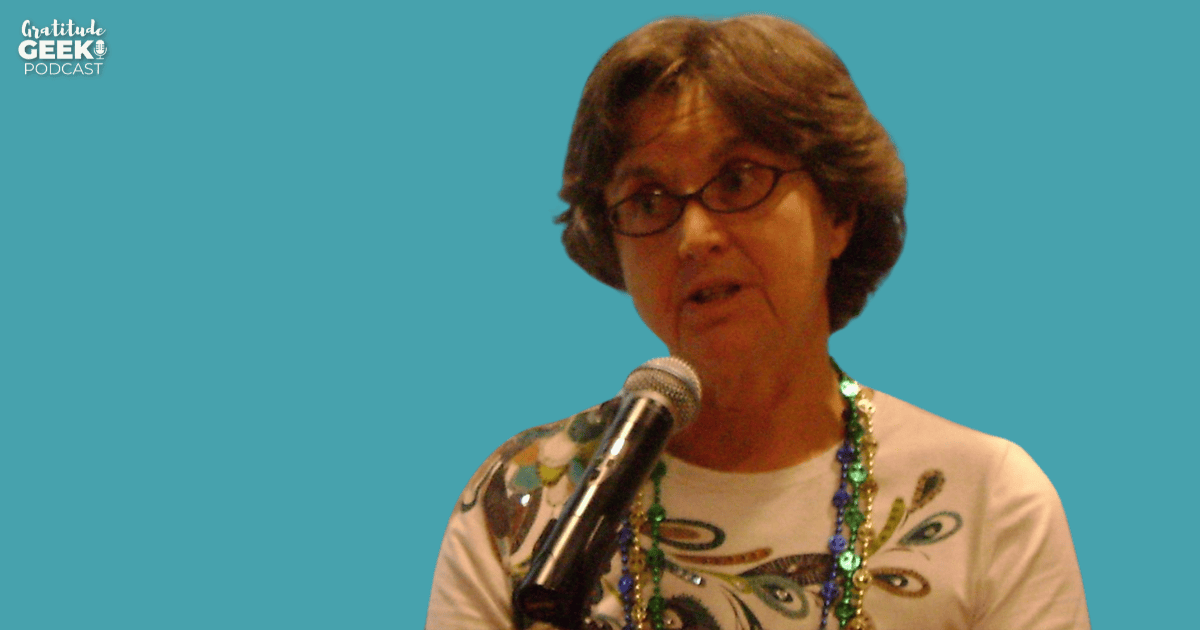
That whisper is where Ann Fonfa’s story starts. I interviewed her in 2014, and I re-released our conversation as Episode 207 after she passed away in February 2024.
Hearing it again, I was struck by how much of what she taught me applies far beyond a health crisis. It applies to anyone rebuilding after a major life disruption and trying to figure out their next move.
Originally aired: February 06, 2024
This post has been updated and republished as part of rebuilding the Gratitude Geek podcast archive.
Key Takeaways
In this episode, you’ll learn:
- A doctor’s prediction describes a group of people, so you get to write your own next chapter.
- Asking the same question year after year, even when nobody answers, can eventually change the whole conversation.
- Complementary and conventional care don’t have to be rivals, and the best plan is the one that fits you.
- Small steps, like one more vegetable, a walk, and seven deep breaths, are easier to start and add up over time.
- Turning your own hard season into information that helps other people can be a form of healing.
Video not loading? Click here to watch on YouTube.
A prediction is not a promise
Ann told me she wrote something back in 2001 that she still believed. Doctors should never tell a patient when they’re going to die.
“I don’t know. How can I know? You’re an individual.”
When my own mother was diagnosed with leukemia, she kept asking her doctor how long she had. He told her a year. She passed away almost exactly a year later. My mother gave herself an expiration date.
I think about this a lot, because my own metastatic diagnosis came with plenty of statistics. Ann helped me see that a number describes a group of people, not me.
My mother’s story is not mine. A diagnosis isn’t a death sentence. It’s a license to live life on my own terms.
If you’ve ever been handed a forecast about your business, your marriage, or your health, remember that someone is guessing. You get to write the next chapter.
Keep asking the question, even when nobody answers
For years, Ann stood up at cancer conferences and asked researchers whether anyone was studying antioxidants alongside chemotherapy. Year after year, the answer was no.
She kept asking anyway. She also mentored other advocates to ask about nutrition and exercise.
Over time, those questions became part of the conversation, and now most cancer conferences, except the most mainstream, include sessions on nutrition, movement, and relaxation.
I love this because it’s such a quiet kind of influence. Ann didn’t have a title or a budget. She had persistence and a microphone at the Q&A. As solopreneurs, we often think we need a big platform to shift an industry.
Ann’s story suggests a good question, asked consistently, can do plenty of the work.
It doesn’t have to be either/or
This is where I want to be careful, because Ann’s story is nuanced. She chose not to do chemotherapy herself, partly because of severe chemical sensitivities.
But her work was never about rejecting conventional care. She told me the things she studied could often be used alongside treatment to reduce side effects and keep the person well.
“We kind of forgot over time that there’s a human being behind that cancer.”
I chose chemo, radiation, and surgery alongside acupuncture and paying attention to my nutrition. Ann didn’t judge that at all. She respected that everybody’s cancer is different, and that the best plan is personal.
A quick note from me. This post shares Ann’s experience and opinions, and it isn’t medical advice. For example, I do not endorse coffee enemas (or horse de-wormer) as treatment for cancer. Please talk with your own care team before changing your treatment.
The bigger lesson reaches past medicine. When two camps are shouting at each other, the most useful answer is often “and.” Your business probably needs both strategy and heart, both systems and spontaneity.
Start with steps so small they’re almost silly
Ann’s organization created something called Three Steps for Health.
- Eat one more fruit and one more vegetable every day.
- Take a walk, with no rules about how far or how long.
- Take seven deep breaths before treatment, before bed, or in a stressful moment.
That’s it. She told me mainstream doctors like the message precisely because it needs no tools, no prescriptions, and no special equipment. She also said the walk is a good reason to skip the escalator.
I find this refreshing, especially if you’re rebuilding and feeling overwhelmed. Nobody can overhaul their whole life on a Tuesday. But one more vegetable, one walk, and seven breaths? You can do that today.
Small habits stack, and Ann believed it was the combination of healthy behaviors that mattered, not any single thing.
Sharing what you learn can be its own kind of healing
When Ann was diagnosed, she wasn’t a serenity person and never became a meditator. What helped her was finding information and sharing it with others. She said that felt like healing.
That instinct grew into the Annie Appleseed Project. She started with paper handouts in 1997 that ballooned to about 65 pages.
Then in 1999, someone told her she needed a website. She didn’t know how, so she learned. The site launched in June 1999 with 65 pages, and 25 people visited, mostly friends.
Then she did what she already knew how to do, which was network and market. She contacted cancer groups one by one and said, “We put up this great article, you should see it.”
As a marketer, I’m delighted by how familiar that is. She started with a tiny audience, kept showing up with value, and reached out personally. That’s relationship marketing in its purest form.
And it all began with turning her own hard season into something useful for other people.
Remembering Ann Fonfa
Ann Fonfa was the founder and president of the Annie Appleseed Project, which provides information, education, advocacy, and awareness on complementary, alternative, and natural cancer therapies.
She was also the founder of the Complementary and Alternative Cancer Therapies conference.
A 32-year breast cancer survivor, she served as a patient advocate for decades, including on the board of the National Breast Cancer Coalition. Ann passed away in February 2024, leaving a legacy that touched thousands of lives.
Mentioned:
Disclaimer: Some links may be affiliate links, meaning I may earn a small commission if you choose to purchase. No added cost to you.
- The Annie Appleseed Project
- The Complementary and Alternative Cancer Therapies conference
- Society for Integrative Oncology
- Project LEAD, the science training program from the National Breast Cancer Coalition
- Cochrane consumer training for reading and understanding studies
- The Department of Defense cancer research program, which recruits patient advocates to review grants
What Will You Keep Asking?
Ann ended our conversation by thanking the advocates who came before her and the ones working beside her. She never talked about being the hero. She talked about being part of a chain.
I keep coming back to her questions that went unanswered for years. They weren’t wasted. Somebody was listening, and eventually the conversation shifted.
So what’s the question you keep asking that nobody seems to answer? And what might change if you asked it one more time?
Stay Groovy!

Gratitude Geek Podcast is made possible by:
Heartbeat.chat, MacKenzie Circle, Goddess Approach, Marketing Podcast Network, HoneyBook, SendOutCards, The Super Patch Co., Podmatch
and listeners like you.


Leave a Reply