

The myth of the lone-wolf entrepreneur is more than just a romanticized narrative. For Gen X solopreneurs, it is a strategic liability.
We are taught that success is the result of individual grit. Yet, for those navigating the volatile landscape of modern business, “going it alone” is a fast track to burnout and stagnation.
If this is your first time here, I’m Kandas Rodarte. It’s lovely to meet you!
I’m an internet marketing pioneer who launched one of the web’s first custom furniture stores in 1998.
I have spent nearly three decades dismantling the “lonely solopreneur” trap. As a “Gratitude Geek” and community architect, I know that true business resilience isn’t found in your tech stack or your systems.
It is found in the social infrastructure you build long before you need it. Community is not a social soft skill. Community is a high-yield business asset.
Recently, I was a guest on the Make Your Passion Pay Podcast hosted by Luann Buechler. We discussed five counter-intuitive lessons on leveraging community as your ultimate competitive advantage.
In this post you’ll learn:
- Why inclusivity is a strategic learning engine that protects you from the Homogeneity Trap.
- How the Star Wars Effect shows that pre-existing trust can collapse timelines for big opportunities.
- How collaboration-focused spaces beat traditional networking and eliminate zero-sum energy.
- How the Law of Two Feet helps you choose aligned cultures and architect your own world belief community.
- How gratitude and the Doorknob Philosophy turn everyday moments into business fertilizer for future growth.

Inclusivity as Strategic Learning
Inclusivity is often framed as a moral obligation, but in a high-growth business context, it is a prerequisite for intelligence. The Homogeneity Trap is the natural tendency to surround ourselves with people who mirror our backgrounds, beliefs, and biases.
While homogeneity feels comfortable, it creates a dangerous echo chamber. Without the friction of diverse perspectives, there is no spark for innovation.
In a homogeneous environment, you are essentially talking to yourself, which is a competitive disadvantage in an evolving market.
I’m a proud “military brat.” Growing up in a family that moved often, taught me early on to welcome the “new kid” or the person with “purple hair.” This isn’t just about kindness. It’s about expansion.
“Without inclusivity you have homogeneity, and that’s boring, there’s nothing to learn. Without inclusivity, you cannot move forward.” – Kandas Rodarte
🔑 Key takeaway: Inclusivity isn’t just kindness. It’s how you keep learning, avoid the Homogeneity Trap, and make your business smart enough to adapt in a shifting market.
The “Star Wars” Trust Effect
In early 2017, I decided to organize a Star Wars Art Festival. By May of that same year—a mere three-month window—I pulled off a massive event featuring 3,000 attendees, 45 artist vendors, three food trucks, and a volunteer force including students from two local high schools.
To an outsider, this looks like a logistical miracle. To a community architect, this was the ROI of a long-term social investment. I didn’t “build” a network in those three months; I activated one that already existed.
You cannot build a community in a crisis or on a deadline. Community is an asset you must cultivate when you don’t need it, so that when a massive opportunity arises, the “pre-built infrastructure” of trust is ready to support rapid execution.
🔑 Key takeaway: When you nurture community before you need it, pre-existing trust collapses timelines, turning “impossible in three months” into “already done.”
Collaboration Beats Networking
Traditional networking often feels transactional and draining because the participants are focused on “taking”—extracting leads, sales, or favors.
I am disrupting this type of energy with my Creator Collab Mixers, specifically designed for women content creators like podcasters and bloggers.
By intentionally labeling the events as “collaboration” rather than “networking,” I aim to fundamentally shift the psychological contract of the room.
This shift removes the “zero-sum game” mentality where one person’s win is another’s loss. Instead, it fosters a “giver” culture.
While the Gratitude Geek Lab serves as a long-term community incubator for experimentation, these Mixers provide a “safe space” where creators feel secure enough to share ideas openly.
When people feel safe, the energy becomes “electric,” and the focus shifts from “What can I get?” to “What can we build together?”
🔑 Key takeaway: Reframing your spaces from networking to collaboration shifts the room from zero-sum extraction to high-energy creation, where everyone’s ideas and momentum grow.
The Law of Two Feet
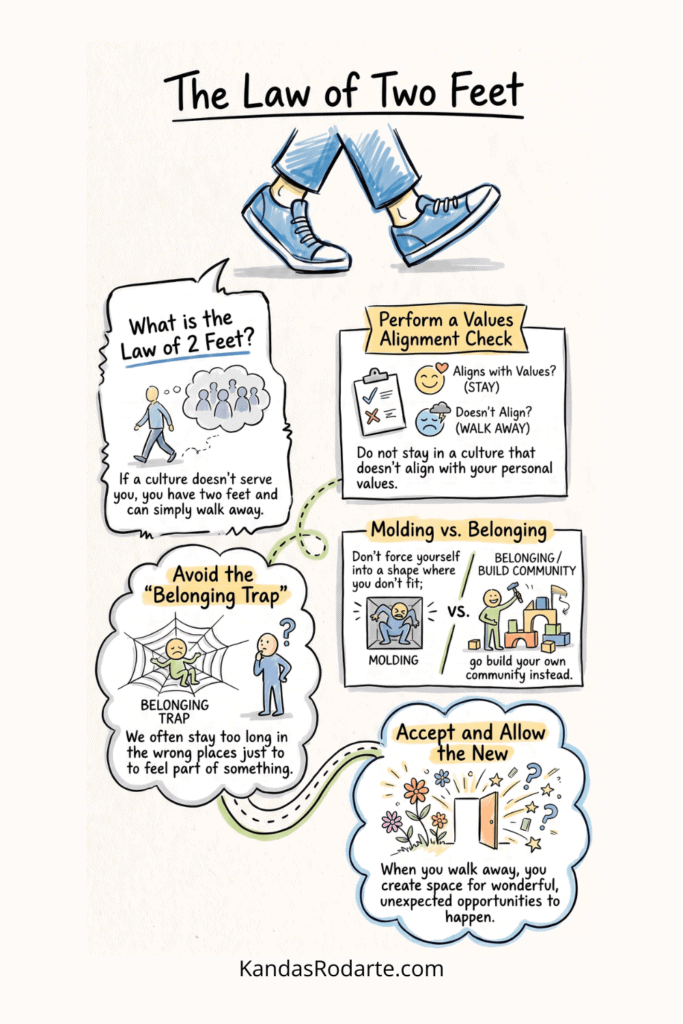
Every community has a culture—and if you don’t intentionally architect yours, one will be created for you. I utilize the Law of Two Feet, a principle I adopted from Mike Roderick.
The Law of Two Feet states that If a community or corporate culture no longer aligns with your values, you have the agency—and the responsibility—to walk away.
Many entrepreneurs fall into the Trap of Belonging, staying in toxic or misaligned environments because they fear the isolation of starting over.
It takes immense courage to recognize when you no longer fit.
Rather than molding your “world belief” to fit someone else’s rigid structure, the most powerful move is to walk away and build your own “world belief” community that attracts others who share your values.
🔑 Key takeaway: Using the Law of Two Feet gives you permission to leave misaligned cultures and design a world-belief community that actually fits your values.
Gratitude as Business Fertilizer
I believe that gratitude is a proactive growth strategy rather than a passive emotion. As I often say:
“Gratitude is like manure; it’s just a pile of poo until you spread it around, and when you spread it around, amazing things grow.” – Kandas Rodarte
When gratitude is “spread” through a business—whether through greeting cards (affiliate link) or making a podcast guest feel like a VIP—it acts as a fertilizer for future opportunities. To implement this daily, try the door knob practice I learned from Rachel Spekman.
Quick Tip: The Doorknob Philosophy
- The Habit: Every time your hand touches a doorknob (or you turn on your microphone), pause for a second.
- The Mantra: Say, “Thank you for this opportunity.”
- The Goal: This creates a constant state of awareness, acknowledging that every door opened is a fresh chance for growth and connection.
🔑 Key takeaway: Treating gratitude as fertilizer—through tiny practices like the Doorknob Philosophy—turns everyday interactions into seeds for future opportunities and deeper community
From “Domesticated” to Fluid Growth
Traditional business is often “domesticated”—it relies on rigid systems, fixed locations, and purely cash-based transactions.
However, a community-led approach allows for a more feral and fluid exchange of value.
Unconventional value exchanges—like professionals who trade high-level housesitting and pet-sitting services—are a way to bypass traditional overhead and gain new experiences.
This is the ultimate evolution of the community mindset. We are moving away from seeing business as a series of isolated transactions and seeing it as a living, breathing garden.
If you treated your network as a garden to be fertilized with gratitude rather than a room to be worked for leads, what kind of opportunities might sprout tomorrow?
Stay Groovy!

Leave a Reply