


The Social Media Reality Check
If you are an independent creator, podcaster, or small business owner, you know the exhaustion of the social media hamster wheel. You spend hours crafting content, tweaking headlines, and attempting to decipher the latest algorithmic updates, all while wondering if any of it actually moves the needle for your business or show.
Having created independent media since 2012 and hosting Gratitude Geek since 2014 (alongside Sci-Fi Book Pod), I have watched platform trends, algorithm shifts, and “guaranteed” growth hacks come and go.
Honestly, most of what gets sold as modern social media strategy is a recipe for burnout.
To separate online myths from real-world strategy, host Amy Stone (The Art of Imperfect Adulting) gathered a panel of veteran independent creators for a candid roundtable discussion on Social Media Reality Check.
The panelists include Maria Medina (Let’s Talk Business), Julie Marty-Pearson (The Story of My Pet), and myself. Together, we pulled back the curtain on algorithm traps, platform ownership, and what actually yields a tangible return on investment.
Key Takeaways
Here are five counter-intuitive truths we uncovered:
- 200,000 Views Won’t Buy You a Cup of Coffee (The Virality Fallacy)
- If a Company Owns It and Requires a Login, It’s Social Media
- Skip the Feed—The Cold DM Is Still the Ultimate Power Move
- The Algorithm Is Built to Trap You—SEO and Owned Assets Set You Free
- Our Collective Relationship Status with Social Media is “Complicated”

Views Won’t Buy Your Coffee
The promise of mass virality is the ultimate social media siren song. Creators are conditioned to believe that if a post explodes, their audience and business will automatically explode with it.
The reality? Generic viral reach rarely translates into meaningful business growth or follower conversion.
I experienced this firsthand on Threads. While attending a rock show with my daughter, who is a professional paleontologist, I picked up a rock I liked. A nearby vendor tried to puff himself up and lecture us, assuming he knew more than we did.
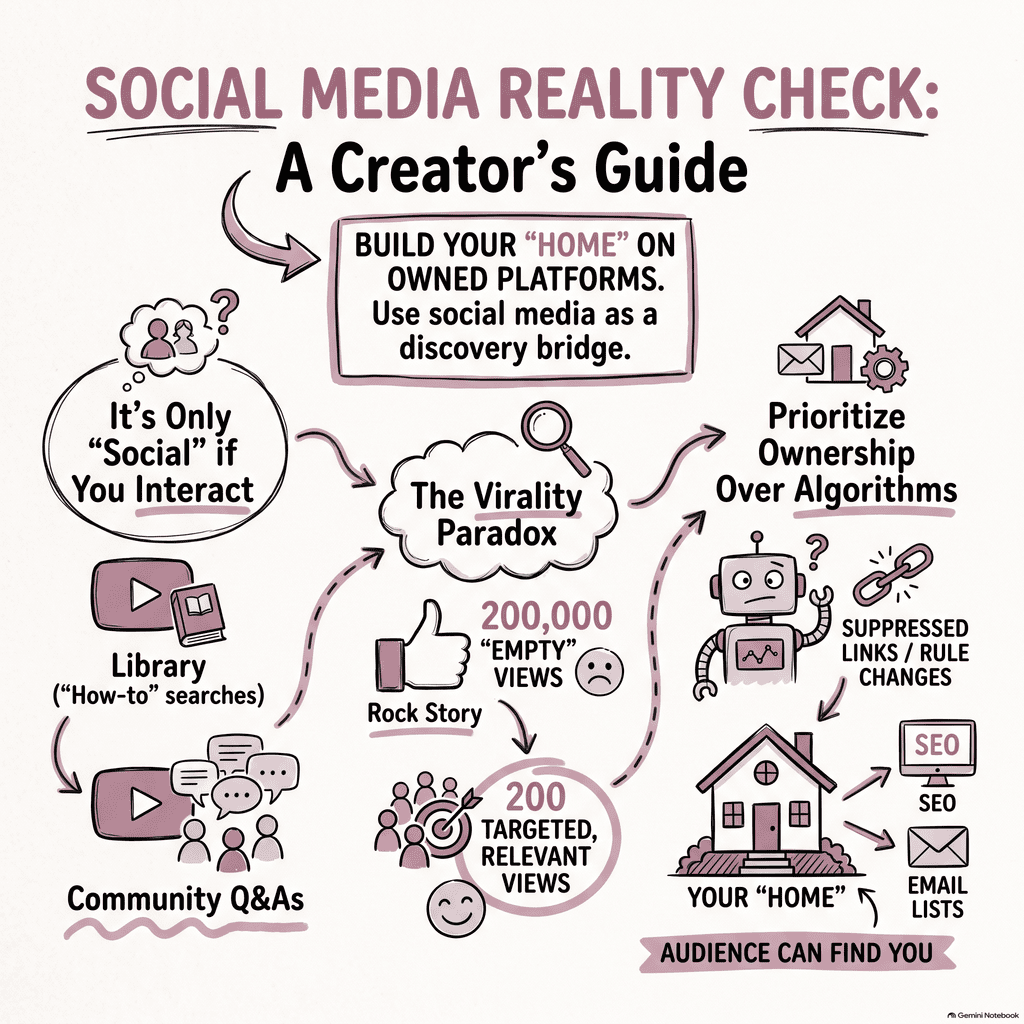
When I calmly informed him that my daughter was a paleontologist and had already explained the rock to me, I put him in his place. I posted the story on Threads, and it blew up to the tune of 200,000 views, triggering hundreds of comments debating the rock, my daughter’s age, and the interaction.
The net result of those 200,000 views? Exactly five new followers and zero dollars in business growth.
“My rock post wasn’t helping my business.”
Mass virality lacks intent. By contrast, targeted or collaborative visibility yields actual results:
- Targeted Community Engagement: Julie adopted two kittens from a well-known rescue organization and tagged the organization in two collaborative posts. Because the content was directly relevant to her pet-focused audience, she gained 212 targeted, engaged followers in just four days.
- Relevant Context: Maria once helped transport 50 rescue cats in a van from Fort Lauderdale to Vermont. When the van broke down in Daytona Beach in the pouring rain, they documented the ordeal. The story caught local news attention, ultimately leading to a donated van for the rescue because the story and the need were aligned. Conversely, when Maria had a localized post go viral in her business, viewers bombarded her with requests to manage their social media—even though she is a business coach, not a social media manager.
If your viral moment isn’t directly tied to what you actually do or who you serve, it is nothing more than digital noise.
Platform Ownership Defines Social Media
What actually qualifies as “social media” today? The definition has shifted dramatically since early platform experiences.
In the early days, creators coded HTML on MySpace to customize profile colors, add background music, and organize their “Top 8” friends. Others navigated early community hubs like Yahoo Groups.
Anyone who remembers Yahoo Groups remembers the notorious reply-to-all floods. If you didn’t have your daily digest settings turned on, someone posting “My power is out!” would trigger 100 notification emails straight to your inbox.
Today, platforms attempt to blur the lines between utility search engines and social feeds. For example, using YouTube to look up a tutorial on how to change your car’s windshield wiper blades is purely informational utility.
However, watching vloggers who host live Q&As or interacting in comment sections transforms that same platform into a social tool.
Platforms actively work to force social behavior to keep user attention within their ecosystem. My definition of what constitutes social media cuts straight to the chase:
“I think that if a company owns it and you have to create a profile, that it’s social media.”
This is why platforms like YouTube aggressively push community posts. YouTube wants user conversations happening natively on their site rather than losing users to external feeds like LinkedIn or Facebook.
If a corporation owns the ecosystem and gates it behind a profile login, you are participating in their social network.
Cold DMs Beat the Feed
Waiting for feed algorithms to distribute your content to ideal guests, clients, or collaborators is a passive game with unpredictable returns. Direct, personal outreach via direct messaging (DM) consistently yields superior tangible opportunities.
When you send a thoughtful DM to high-profile figures, you bypass algorithmic gatekeeping entirely. Early in her show’s lifecycle—within her first 10 episodes—Julie sent a cold DM to a prominent True Crime podcaster who co-hosted a show for the LA Times. The host accepted, leading to a great interview where they bonded over Bravo shows.
I have experienced the exact same power move in my own media journey:
- Allan Dib: I sent a DM on LinkedIn to Allan Dib, author of my absolute favorite marketing book, The One Page Marketing Plan, asking him to be a guest on my show. He said yes almost immediately and subsequently introduced me to his professional network.
- Joshua Dalzell: I sent a Facebook message to my favorite science fiction author, Joshua Dalzell, asking him to join my podcast. He agreed, came on the show, and later introduced me to his narrator, Paul Heitsch. Paul has since appeared on both of my podcasts, and we remain direct messaging contacts today.
| Method (Chasing Algorithms vs. Direct Outreach) | Outcome / Creator Impact |
|---|---|
| Chasing Feed Algorithms | Subject to fluctuating reach, zero guaranteed link clicks, and passive consumption without real connection. |
| Direct Outreach (Cold DMs) | Secures high-profile guest bookings (e.g., Allan Dib, Joshua Dalzell), builds referral networks, and establishes direct creator-to-creator relationships. |
Owned Assets Beat the Algorithm
Building a business exclusively on rented platform feeds exposes creators to sudden policy changes designed to restrict outbound traffic. Platforms do not want users leaving their site.
For instance, Meta implemented rules restricting Facebook business pages to just two outbound links per month before requiring paid promotion to share more. Furthermore, feed algorithms frequently suppress external links or alter user feeds—such as prioritizing group discussions over individual friend updates to compete with community platforms like Circle.
Relying on algorithms to distribute your media puts you in a position of low control. Search Engine Optimization (SEO) and owned assets work differently by relying on user search intent rather than platform distribution traps.
During a three-month hiatus specifically from posting about my podcasts on social media feeds (I stayed on Threads purely for personal entertainment), I shifted my focus entirely to SEO and query-based search intent.
When conducting audience research on Google, I discovered that Google AI highlighted my Apple Podcast link as the very first search result for my ideal audience query.
By optimizing owned assets for search intent rather than feeding algorithmic platforms, independent creators build long-term discoverability that operates independently of social feeds.
Our Complicated Relationship with Social Media
When veteran women creators evaluate their day-to-day relationship with social platforms, the consensus is far from enthusiastic. Independent creators feel pulled between the necessity of discoverability and the frustration of constant algorithmic friction.
A major source of this friction is how platforms gatekeep analytics. Maria brought up the phenomenon of “silent watchers”—passive viewers who consume full 30-minute episodes month after month without ever clicking “like” or leaving a comment, yet quietly convert into high-value buyers.
Independent creators need deeper analytics to understand these high-intent viewers, but platforms like YouTube hide deeper viewer intent data until creators hit massive volume thresholds.
At the conclusion of our roundtable, the panelists summarized their current relationship with social media in single words:
- Julie: Angst
- Maria: Conflicting
- Kandas: Complicated
Recognizing these complexities allows creators to set realistic expectations, stop measuring their worth by vanity metrics, and establish healthier boundaries with social networks.
Reframing Social Media as a Party, Not the Foundation
Social media should be treated like a party—a place to drop in, network, make direct connections, and enjoy the entertainment. It is not the structural foundation of a media business.
Search engine optimization, owned email lists, and direct RSS distribution serve as the actual engines for sustainable, long-term growth.
As you evaluate your strategy moving forward, ask yourself this critical question:
Is your current social media strategy building your own long-term platform, or are you simply working for someone else’s?
Stay Groovy!


Leave a Reply